ChatGPT vs Language Learning Apps: Which Is Better?
A general AI chatbot is a capable grammar coach and conversation partner, but not a language learning system. Here is how to use each well.
ChatGPT is excellent for grammar explanations, translation with context, and on-demand vocabulary help. It has no pronunciation audio, no structured scenarios, and no conversation review. A purpose-built language app covers those gaps. Use both for what each does well.
A lot of learners reach for ChatGPT when they want to add speaking practice, after seeing it discussed in language-learning communities online. Results are often surprisingly good in some areas and consistently limited in others. The difference is worth understanding clearly before building a practice system around either tool.
What ChatGPT does well for language learning
ChatGPT handles several language learning tasks genuinely well. For the right job, it is among the most capable tools a learner has access to.
Grammar explanation
Ask ChatGPT why a sentence works the way it does and you will receive a clear, patient explanation in plain language, illustrated with examples drawn from your own sentences if you provide them. Ask why Korean verb endings change depending on the following word, why Spanish has two verbs for "to be," or why French past tenses behave the way they do. It handles all of these on demand, at any hour, with no impatience. Grammar explanation is one of the most labour-intensive parts of learning with a human tutor; ChatGPT handles it at no cost per question.
Translation with context
The gap between "here is the translation" and "here is why this word and not that one" is significant. ChatGPT provides the explanation alongside the translation: the register difference between two near-synonyms, the situations where an idiomatic phrase works better, the alternative ways to express the same idea at different levels of formality. This is translation as learning material, not just translation as output.
Vocabulary in context
Ask for example sentences with a new word. Ask for the most common collocations. Ask for the five most natural ways a native speaker would express the same concept. This is vocabulary acquisition done correctly: embedded in meaning and context rather than presented as isolated word pairs.
Writing feedback
Paste a paragraph you wrote in your target language and ask for corrections with explanations. This is significantly more useful than a spell-checker that marks errors without explaining them. For learners who write in their target language (journaling, messaging, practice texts), ChatGPT as a writing coach is a genuinely effective use of the tool.
Casual conversation practice
ChatGPT holds a conversation in any language on any topic. Ask it to speak only in Korean, or to hold the conversation in Korean while understanding your English responses. Ask it to correct your errors inline, or only when they affect comprehension. The flexibility is real.
Where ChatGPT falls short
The limitations are structural, not accidental. They reflect what a general-purpose AI chat tool was built to do.
No pronunciation audio
ChatGPT can describe how a sound should be produced. It can explain that the Korean consonant ㄹ has a liquid quality that falls between L and R, that Spanish rr requires tongue vibration against the alveolar ridge, or that Mandarin fourth tone drops sharply from high to low. What it cannot do is say the word. There is no audio output. You read the description, but you cannot hear the target, which means you cannot compare your own pronunciation to it. For a spoken language, this is not a missing convenience feature. It is an absence at the core of what building speaking fluency requires.
No structured scenario practice
ChatGPT is open chat. You choose the topic, set the difficulty, decide what vocabulary you want to encounter, and end the session whenever you choose. In practice, most learners unconsciously practice what they can already say. They discuss familiar topics, avoid subjects where they lack vocabulary, and never encounter the specific phrases that real-world situations require before they actually need them in real life.
Structured scenarios solve this. A taxi roleplay places you in a specific situation (giving directions, asking for an estimated fare, handling a misunderstanding with a driver) with vocabulary and phrasing that belongs to exactly that situation. You repeat the scene until the key phrases feel automatic. That does not happen in open conversation.
No conversation review
When the ChatGPT session ends, it is gone. No vocabulary was captured. No record of what you covered was saved. The words you reached for and could not find, the grammar pattern that derailed a sentence halfway through, the topic you steered around because you lacked the vocabulary: none of it becomes study material. This is a significant cost, because the vocabulary you needed in a real conversation, even a simulated one, is among the most retainable material available to you. ChatGPT discards it.
No native speaker access
Every ChatGPT conversation, regardless of what language it is conducted in, is a conversation with an AI. For learners who want authentic interaction with a real native speaker before they reach fluency, this is a gap that no prompt configuration addresses. The accent calibration, the cultural subtext, the conversational unpredictability of real people: these come from real human conversation.
What purpose-built language apps add
Each gap above maps to something a purpose-built language app is designed to address.
Pronunciation you can hear
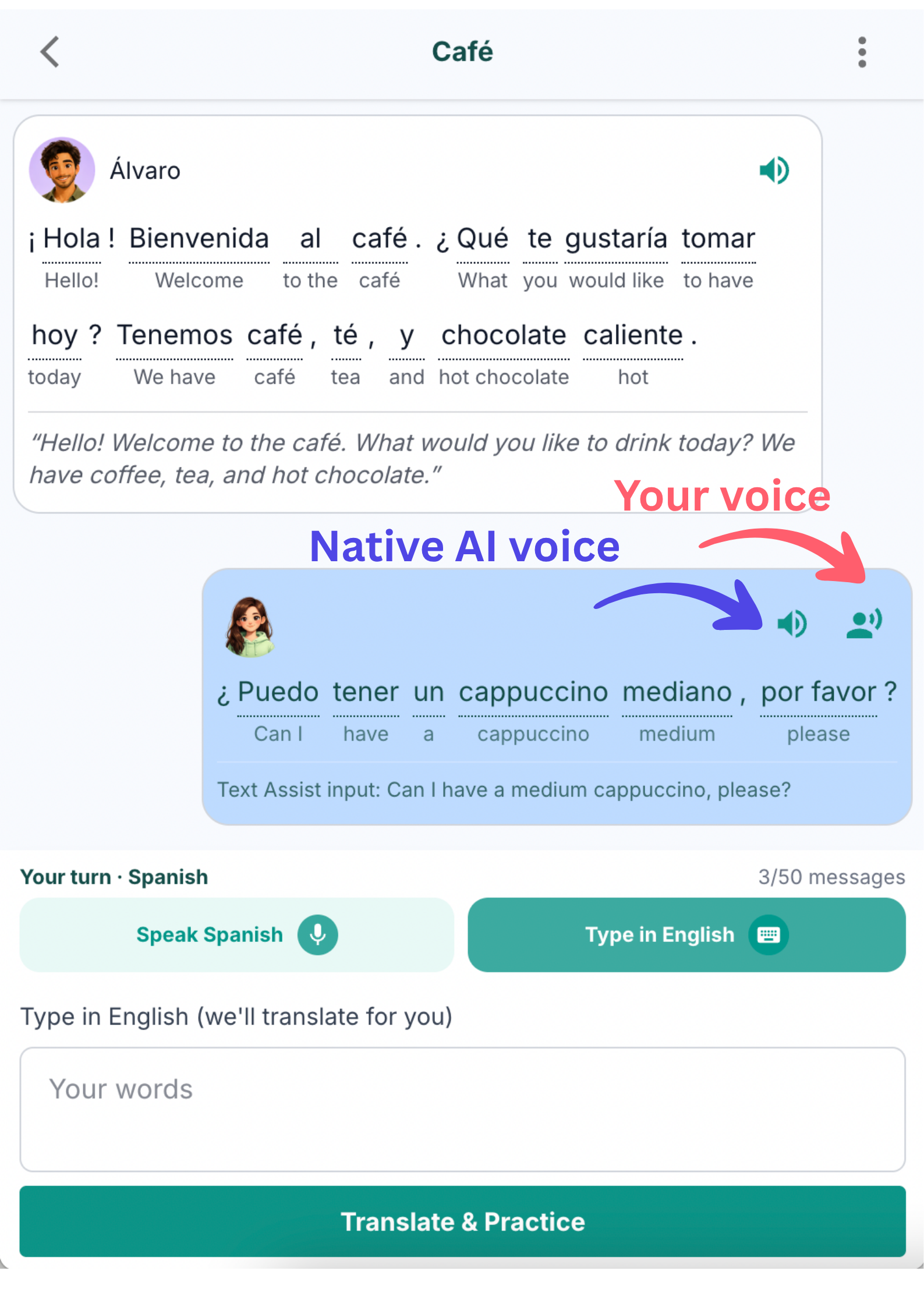
Every sentence in a PalmSpeak roleplay scene plays in your target language on demand. Every word in a conversation can be tapped to hear it in isolation. For your own spoken turns, the app stores two things side by side: the AI character's pronunciation of the same sentence, and your own recording. You hear the target and hear yourself, without a score or grade: just direct comparison. This is a fundamentally different experience from reading a text description of how a sound should work.
Two recordings, side by side. No grades, just your ear.
On every sentence you speak, PalmSpeak saves two recordings next to each other: the AI character's native pronunciation of that exact sentence, and your own voice speaking it. Tap both. Hear the gap. No score, no analysis. Just the direct comparison your ear needs to self-correct. ChatGPT cannot play a single word for you.
Free forever plan · No credit card required
Try a free conversation scene →Structured real-world scenarios
Roleplay scenes are built around situations you will actually face: ordering at a restaurant, checking into a hotel, taking a taxi, handling a job interview, making plans with a friend. Each scene has a defined context, a consistent AI character, and the vocabulary that belongs to exactly that situation. You can repeat any scene until the key phrases feel automatic before moving on. The structure removes the decision fatigue of open conversation and builds the scenario-specific fluency that real travel and real conversation require.
Conversation review
Every session is saved. Every word you encountered appears with its translation and audio. Vocabulary from your roleplay sessions can be reviewed with full sentence context: not as an isolated word pair, but in the sentence where you first needed it. The words you reached for and could not find during a scene become the next batch for review. Nothing from your practice sessions is discarded.
Real conversation, today
The Talk feature provides real-time translation in a genuine conversation with a real native speaker. Not when you reach a certain fluency level. In a conversation you are having today. This is the element that no AI chat tool can offer, because real human conversation is precisely what AI is not.
How to use both
The right answer is not one or the other. These tools serve different functions within the same practice system.
Use ChatGPT when you want to understand why a grammar rule works the way it does, you encounter a phrase in a real conversation and want more than a dictionary definition, you want to proofread something you wrote before sending it, or you want to generate vocabulary for a specific topic you are preparing for.
Use a purpose-built language app for daily structured speaking practice, pronunciation listening and direct comparison, vocabulary capture from every session, and real-world scenario practice that prepares you for specific situations before you face them in real life.
The division of labour is clean. Grammar coach and vocabulary reference on demand: general-purpose AI. Structured daily speaking practice with review and pronunciation reference: purpose-built language app. Neither does the other's job well. Both together produce better outcomes than either alone.
PalmSpeak
Practice Speaking From Day One
Jump into a structured scene and practice speaking in context: no partner needed, no judgment, available any time.
Free forever plan · No credit card required
Start a free conversation →Common Mistakes to Avoid
Using ChatGPT as your only speaking practice
Fix: ChatGPT will hold a conversation in any language you choose. That is genuinely useful. It is not structured speaking practice. You decide the topic, the difficulty, and when to stop, which means most learners unconsciously practice what they can already say. Structured roleplay scenarios place you in a specific real-world situation with vocabulary and context relevant to exactly that situation, repeated until the responses feel automatic. Open-ended AI chat does not produce that outcome.
Treating ChatGPT and language apps as competitors
Fix: They serve different functions. ChatGPT is strong at grammar explanation, translation with context, and vocabulary on demand. Purpose-built language apps handle structured speaking practice, pronunciation reference, conversation review, and vocabulary capture from your sessions. These functions do not overlap in any meaningful way. Using both for what each does well produces better results than choosing one and dismissing the other.
Continue Reading
AI Language LearningResearch
Is an AI Language Tutor Effective? What the Research Shows
What the evidence shows about AI-assisted language acquisition and the conditions that make it work
Read more →
Tutors
Can AI Replace Language Tutors? An Honest Answer
What AI does better than a human tutor, what it cannot replicate, and the hybrid model that works
Read more →
Tools
Translation Apps vs Language Learning Apps
What each category is built for and how to use both in one coherent practice system
Read more →
Frequently Asked Questions
Should I use ChatGPT or a language learning app?
Is ChatGPT good for learning a language?
Can ChatGPT correct my grammar mistakes?
Can ChatGPT help with pronunciation?
Is ChatGPT free for language learning?
The conversation is waiting.
PalmSpeak guides you into real speaking situations from your first session. No partner needed, no prep required.
Free forever plan · No credit card required
Start a free conversation →