Most people learn languages exactly the way they were taught in school: memorize vocabulary lists, study grammar rules, complete exercises. That approach produces test scores. It rarely produces fluency. The research on how language actually gets into your brain tells a different story.
Ranked by how directly the research supports them, the seven most effective language learning methods are:
- Comprehensible input: learning from content you mostly understand
- Spaced repetition: reviewing vocabulary at increasing intervals
- Active recall: testing yourself instead of re-reading
- Pushed output: speaking and writing under real pressure
- Shadowing: training pronunciation at the sound level
- Deliberate practice: targeting your specific weak points
- Extensive reading: building volume of understood input
1. Comprehensible Input: The Foundation of Acquisition
Here's something that changes how you think about language learning. Linguist Stephen Krashen figured out in 1982 that you don't actually learn a language by studying it. You acquire it naturally, almost without trying, when you spend time with content you mostly understand. He called this Comprehensible Input, part of his broader Input Hypothesis, and it remains the most-cited theory in second language acquisition research.
The key is that word mostly. Krashen described the sweet spot as "i+1", meaning your current level (i) plus one step. If you understand everything, there's nothing to stretch you. If you understand almost nothing, you're just lost. The productive zone is content where you understand about 95% and have to work out the rest from context. That gap-filling process is where real acquisition happens.
Why it works
Paul Nation at Victoria University has built one of the strongest research cases supporting this. His finding: learners who read large amounts in their target language pick up vocabulary and grammar patterns with minimal explicit study. Encountering a word naturally in context ten to twenty times produces stronger long-term retention than studying the same word six times on isolated flashcards. Context is doing real cognitive work.
How to apply it
- Graded readers: books rewritten at controlled vocabulary levels. At A2, you'll understand about 95% of the text, right in Krashen's comprehensible zone. Below that threshold, reading becomes frustrating rather than productive.
- Learner-targeted listening content: audio and video produced specifically for non-native speakers at a reduced pace with controlled vocabulary. Look for material described as "comprehensible input" or "beginner listening" in your target language. For a more adaptive alternative, AI conversation calibrates its language to your current level automatically: every exchange functions as comprehensible input at your exact i+1, and the difficulty shifts as you improve rather than staying fixed at one level.
- Native content with target-language subtitles: once you reach B1, watching TV in your target language with target-language subtitles (not your native language) keeps you at i+1 for listening while the text gives you an anchor.
One thing to know upfront: Comprehensible Input is exceptional for building passive understanding and reading ability. It does not, on its own, teach you to speak. That's what Merrill Swain's research addresses in Method 4. For a deeper breakdown of the gap between understanding and speaking, see the complete language learning guide.
2. Spaced Repetition: The Most Efficient Vocabulary Method
Spaced Repetition (often shortened to SRS) is the most well-researched vocabulary method in existence, and it goes back further than you might think.
In 1885, German psychologist Hermann Ebbinghaus mapped out exactly how human memory decays after you learn something, what he called the Forgetting Curve. Memory doesn't fade at a steady rate. It drops sharply at first, then levels off. Every time you review something, that curve resets, and the next forgetting takes longer. The practical upshot: reviewing a word at exactly the right moment, just before you'd have forgotten it, is dramatically more efficient than reviewing it at fixed intervals or whenever you feel like it.
That's the logic behind Spaced Repetition. A flashcard system that uses it tracks which words you know well and which you're shaky on, then schedules your reviews accordingly. Words you keep forgetting come up more often. Words you've locked in get pushed further out. The system does the cognitive heavy lifting so you don't have to.
What the numbers show
Nicholas Cepeda and colleagues tested this in 2006 in Psychological Science, tracking thousands of learners across distributed versus massed practice (studying something repeatedly in one session). Their finding: when the goal was retention one month later, distributed practice produced retention rates ten times higher, in the same total study time. You're not studying harder. You're studying at the right moment.
How to apply it
- Build sentence cards, not word cards: this is the single most important thing to get right. Your brain encodes vocabulary in context. A card showing "la profesora elogió su trabajo" (the teacher praised his work) teaches the word elogiar in a real sentence pattern. A card showing "elogiar = to praise" teaches you almost nothing useful for actual conversation.
- Start with the most common words: the top 500 to 1,000 most-used words in your target language give you disproportionate coverage. Build that base before going wide.
- Keep reviews short and daily: 15 minutes a day consistently beats two-hour weekend sessions. Spaced Repetition works through regularity: the intervals only compound if you show up.
A practical shortcut: in PalmSpeak, any word you tap during an AI roleplay scene or a real conversation with a local can be saved to your vocabulary lists with the full sentence it came from. When you review during a practice session, the flashcard shows the exact context you first encountered it in, not a bare definition.
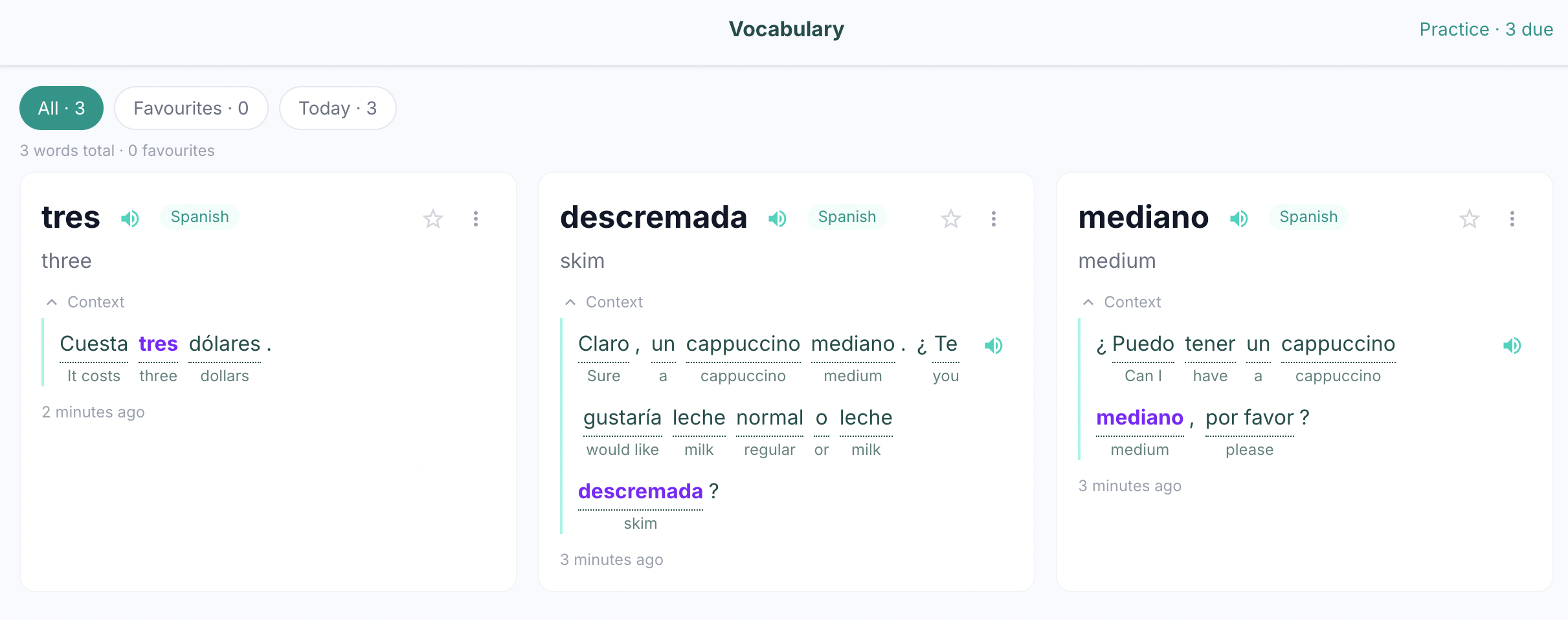
Every saved word keeps the sentence it came from. You review vocabulary the way you first met it, not as an isolated translation pair.
Free to try
Try vocabulary in PalmSpeak3. Active Recall: Learning by Testing, Not Re-Reading
Here's a counterintuitive finding that completely changes how you should study: testing yourself works better than studying.
Not slightly better. Henry Roediger III and Jeff Karpicke at Washington University demonstrated in 2006 that students who studied material once and then tested themselves three times retained significantly more one week later than students who studied the same material four times. Same total time, meaningfully better retention.
The reason is in the act of retrieval itself. When you struggle to pull something out of memory, even when you're not sure you'll get it right, you're strengthening the memory trace in a way that re-reading simply cannot replicate. The difficulty is the point. Psychologists call this the testing effect.
The research behind it
Dunlosky and colleagues (2013, Psychological Science in the Public Interest) reviewed ten popular study techniques. Re-reading, highlighting, and summarizing (the things most learners default to) were all rated low utility. Retrieval practice was rated high utility. It's one of the most consistent findings in cognitive psychology, and most language learners still ignore it completely.
How to apply it
- Use your flashcards properly: every flashcard review is an active recall exercise, but only if you actually attempt the recall before flipping the card. See the prompt, try to remember the answer, then check. Don't flip early. The moment of not-yet-knowing is where the learning happens.
- Self-quiz after studying: after covering a new grammar pattern or a vocabulary set, close everything and write or say everything you can recall. Check what you missed. This is consistently more effective than re-reading the same material.
- Output journaling: write a short paragraph in your target language each day without looking anything up. The words and structures you can't produce reveal exactly what to study next.
Spaced Repetition and Active Recall work together. Spaced Repetition determines when to review. Active Recall is the review itself: the moment of testing before the answer is revealed. In PalmSpeak's vocabulary tab, the flashcard review puts Active Recall into practice. You see the word and the sentence it came from, try to recall the meaning, then mark whether you've got it or need another pass.
4. Pushed Output: Why You Have to Speak to Learn to Speak
Here's the gap that trips up almost every language learner: you can understand a language far better than you can speak it.
Merrill Swain noticed this in 1985 while studying French immersion students in Canada. These kids had spent years surrounded by French. Their listening comprehension was strong. But their spoken French, including the grammar, the accuracy, and the fluency, lagged far behind their understanding. Comprehensible Input had built their passive knowledge. It hadn't trained them to produce.
Swain's insight, which became the Output Hypothesis: speaking requires a completely different neural pathway than understanding. You have to actually produce language: reach for words, construct sentences under pressure, and notice where you fall short. That's the only way to build that pathway. Listening alone will never get you there.
Why pushing yourself matters
When you're trying to speak and can't find the word, or you're unsure about the grammar, something important happens: you notice the gap. Richard Schmidt (1990) called this the noticing hypothesis: the moment you notice a gap in your own production is exactly what directs your attention toward filling it. Input doesn't force that noticing. Output does. This is why learners who only consume content plateau, and learners who speak from the beginning keep improving.
How to apply it
- Speak from day one, even imperfectly: there's no research supporting the idea that you should wait until you have "enough" vocabulary or grammar before speaking. The speaking pathways require training through use. Every day you don't speak is a day those pathways stay dormant.
-
Practice with AI conversation tools: for most people, this is the most practical starting point. An AI responds in real time, doesn't judge your accent or your grammar, and keeps the conversation going without embarrassment. Krashen showed that anxiety actively blocks language acquisition. AI conversation removes that barrier so you can build the habit before scaling to human partners.
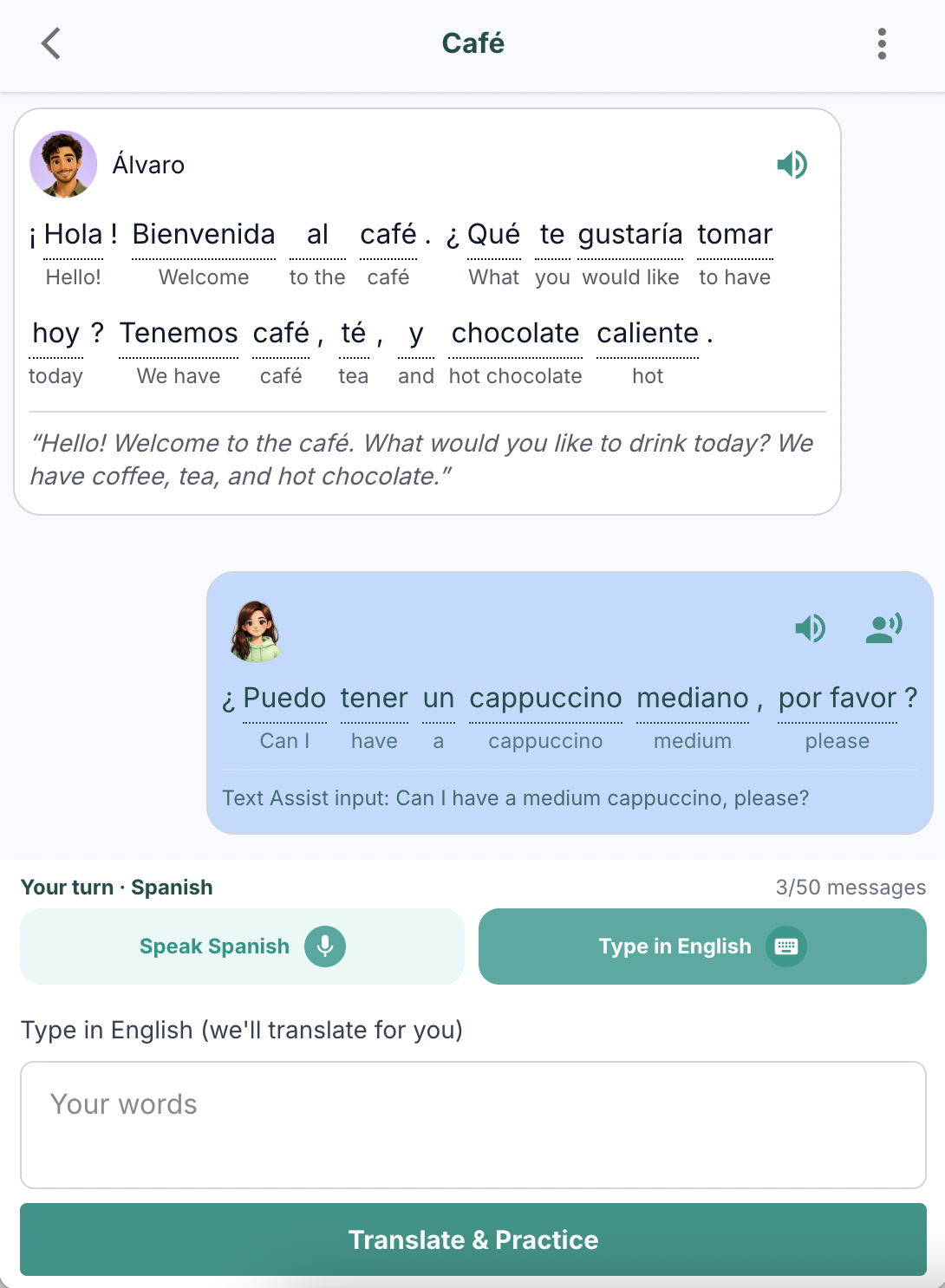
A café roleplay in PalmSpeak: the AI responds in your target language at your level, with word-by-word translations so you always follow. Speak or type to keep the conversation going.
Free to try
Start a conversation in PalmSpeak - Language exchange: speaking with a native speaker who is also learning your language reduces the stakes on both sides.
- Give your practice a production target: not "let's have a conversation today" but "I'm going to use the subjunctive at least five times and pay attention to every one." Specificity is what separates deliberate practice from comfortable chat.
If you encounter native speakers in daily life (a taxi driver, a café owner, a local at a market), PalmSpeak's Talk feature turns those moments into structured practice. The local speaks; the app shows a word-by-word translation in real time so you can follow along. You respond in English and hear your response played back in the target language with full translations. The conversation is saved so you can revisit it afterward: how that particular person spoke, the phrases they used, what you missed in the moment. Every real-world encounter becomes a lesson you can return to.
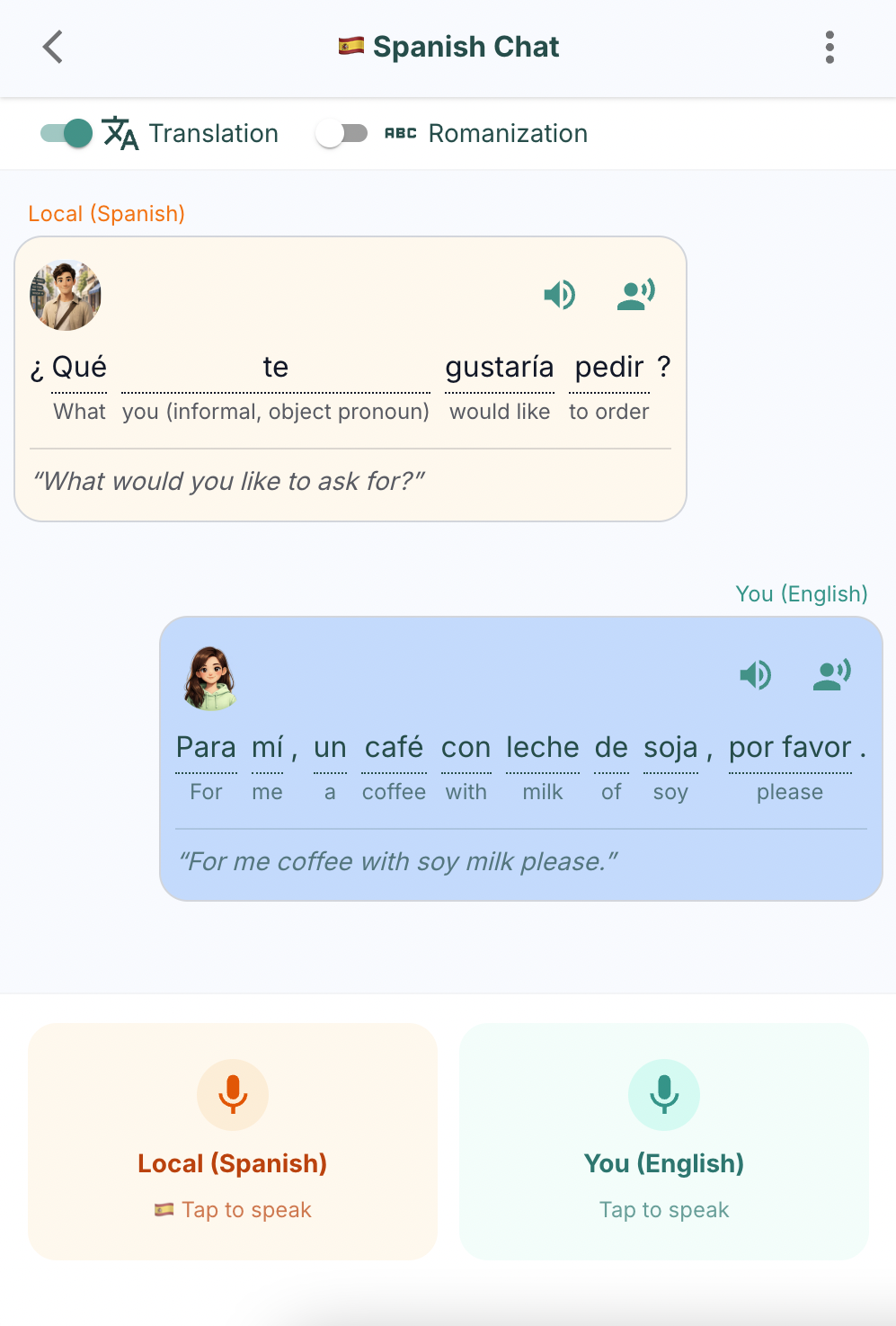
PalmSpeak's Talk feature translates a real local's speech word by word as they speak. Tap any word to hear it or save it to your vocabulary lists.
Free to try
Start Practicing FreeFor structured speaking practice from day one, see the Speaking and Conversation Guide.
5. Shadowing: Training Pronunciation at the Sound Level
Shadowing sounds deceptively simple: listen to a native speaker and repeat what they say at exactly the same time. Not after. At the same time.
Polyglot Alexander Arguelles developed and popularized the technique in the 1990s. The mechanism runs deeper than it looks. Alan Baddeley's research on working memory (1992) identified what he called the phonological loop, the brain's short-term rehearsal system for sounds. When you shadow, you're drilling native pronunciation patterns directly into that loop. That's why regular shadowing produces natural rhythm and intonation that traditional pronunciation drills never quite manage.
What the research found
A 2015 study in the Language Learning Journal (Hamada) compared shadowing against conventional listening exercises over eight weeks. The shadowing group improved significantly more in listening comprehension, pronunciation accuracy, and prosody, the natural rhythm and music of the language. The mechanism appears to be perceptual learning: producing what you hear simultaneously trains your ear to distinguish sounds your native language doesn't separate.
How to apply it
- Start at 75% speed: slow the audio down until you can keep up comfortably. Increase speed only when you can match the speaker reliably at that pace.
- Whisper shadow before going full volume: whispering first removes the pressure of managing your own voice, so you can focus purely on matching the sounds.
- Choose clear, naturally spoken audio: learner podcasts and news broadcasts work better than casual conversation recordings, which often have too much background noise and reduced speech.
- Move to content you actually enjoy: shadowing something interesting means you'll keep doing it. Engagement matters more than perfect audio quality.
Shadowing is especially powerful for languages whose sound system differs significantly from English: Korean, Japanese, Mandarin, Arabic, Vietnamese. If you're learning one of these and pronunciation feels like a wall, shadowing is the most efficient way through it.
6. Deliberate Practice: How to Break Through the Intermediate Plateau
Most people plateau not because they stopped studying, but because they stopped being uncomfortable.
K. Anders Ericsson studied expert performance for decades across music, chess, and sport. His finding, published in Psychological Review in 1993, was consistent: what separates people who keep improving from people who stop is not the hours they put in. It's whether those hours are deliberate: focused effort targeting your current weaknesses, at the edge of your ability, with feedback on whether you're doing it right.
The hours don't count if they're comfortable
This is the part most people get wrong about effort. It's not about accumulating time. Ericsson's research showed that deliberate practitioners spend significantly more time in discomfort than average performers. Applied to language: one hour of targeted conversation where you're being corrected and pushed produces more acquisition than five hours of comfortable small talk where you're saying the same things you already know how to say.
How to apply it
- Name your specific weakness before you start: not "I'll practice Spanish today." Something targeted: "I keep confusing the preterite and imperfect, and I'm going to use the imperfect deliberately in today's session and track every time I get it right."
- Work with a tutor who gives feedback, not just conversation: a tutor who lets errors pass isn't giving you deliberate practice. A tutor who stops you, corrects you, and makes you try again is. The distinction matters more than the price.
- Listen back to your own recordings: hearing yourself is uncomfortable, and that's exactly why it works. Errors you can't catch in real time become obvious on playback. This is the feedback loop deliberate practice depends on. In PalmSpeak, your voice is recorded when you speak during an AI roleplay scene, so you can listen back to how you actually sounded in context.
- Review real conversations, not just your own output: if you've used PalmSpeak's Talk feature during a real encounter, the saved recording gives you a second layer of deliberate review. Listen back to what the local actually said: the phrases they chose, the pronunciation, the rhythm of natural speech. Notice what you missed in the moment. Authentic conversation recorded in context is more memorable than any scripted audio, because you were there and you know exactly what was happening.
- Let it feel hard: if every session feels easy, you've settled into comfort. The edge of your ability is exactly where improvement happens.
Deliberate Practice is most important at the intermediate stage, where general input and output no longer force progress because you've learned to communicate without accuracy. This is the method that takes you from functional to genuinely fluent.
7. Extensive Reading: The Compound Effect of Volume
There's a simpler side of language learning that tends to get overlooked: reading a lot.
Not intensive study, not grammar analysis. Just extensive reading, large volumes of content at a comfortable level. Paul Nation at Victoria University has built the most thorough research base behind this approach. His key finding: once you know about 95 to 98 percent of the words on a page, vocabulary and grammar patterns are absorbed through sheer exposure volume. No deliberate study required. The reading does the work.
What happens when you read at volume
Waring and Takaki (2003) tracked how much vocabulary learners picked up simply from reading a 700-page graded novel over several weeks, without studying any of the words explicitly. Learners acquired between 15 and 30 percent of the words they'd encountered in context, through reading alone. Mason and Krashen (1997) compared extensive readers against a traditional grammar instruction group over a full academic year. The readers outperformed the grammar group on both reading and writing tests. Nation estimates that reading ten novels a year in your target language produces roughly 1,000 to 1,500 new vocabulary items, passively, through enjoyment.
How to apply it
- Graded readers first: books written for language learners at controlled vocabulary levels. Find the level where you understand 95% without a dictionary and start there. Most graded reader series span A1 through C1, with the level and approximate word count marked on the cover so you can find your entry point quickly.
- Move to native content you'd genuinely choose: reading about something you're curious about produces better retention and sustains the habit. Learning Japanese because of anime? Read manga before novels. Learning Spanish? Try a sports column before literary fiction.
- Save words as you go: when you encounter a word worth keeping, note it down and add it to your vocabulary review list. In PalmSpeak, words saved from conversations come with their original sentence attached, so when you review them later, you see the full context you first encountered them in.
One honest limitation: Extensive Reading builds reading comprehension and passive vocabulary. Like Comprehensible Input more broadly, it doesn't train speaking or pronunciation. It works best as one part of a fuller practice routine alongside a Pushed Output method.