How to Talk to Native Speakers Before You're Fluent
Most learners put off talking to native speakers until they feel ready, a readiness that rarely arrives in time. Genuine conversations are possible today.
Waiting until you feel ready to talk to native speakers usually means waiting indefinitely, because the sense of readiness keeps receding. Genuine conversations are possible before fluency by starting with supportive speakers, short exchanges, and tools that bridge the gaps, and early speaking accelerates progress.
The Myth of Being Ready
The single most common mistake language learners make is waiting.
Waiting until their grammar is more solid. Until their vocabulary is larger. Until they feel confident. Until they have practised more. The threshold for "ready" shifts forward constantly, which means most learners delay their first real native-speaker conversations for months, sometimes years.
Here is what the research consistently shows: learners who begin conversations with native speakers early, even with very limited fluency, reach conversational fluency faster than learners who delay. The mechanism is straightforward. Real conversations provide a type of input and output practice that nothing else replicates. They expose you to how language is actually used, force you to produce language under real conditions, and create the kind of memorable, emotionally charged experience that language memory builds on.
You do not get ready for real conversations by studying. You get ready by having them.
What Real Conversations Give You That Nothing Else Can
Textbooks, apps, and AI practice are all valuable. None of them replicate the specific language experience of a real conversation with a native speaker.
Authentic language in natural use. Native speakers do not speak the way textbooks write. They use connected speech, contractions, filler words, regional expressions, and cultural references that only appear in real conversation. Hearing this regularly is what eventually makes you sound natural yourself.
Genuine unpredictability. Every real conversation takes unexpected turns. Questions you did not prepare for. Topics you did not anticipate. Responses that require you to construct entirely new sentences on the fly. This unpredictability is exactly what makes real conversations the highest-quality speaking practice available.
Motivational depth. Many learners who struggle to sustain long-term language learning find that the first real conversation with a native speaker changes their relationship with the language entirely. A genuine human connection in another language is a different experience from practising alone. It makes the language real in a way that no amount of solo practice achieves.
Cultural context. What people actually talk about, how they express things, what is considered polite or impolite, what questions are normal and which are unusual: this knowledge only comes from real interactions. It cannot be taught; it has to be experienced.
How Real-Time Translation Changes This
The traditional barrier to early native-speaker conversations was the language gap itself. Real-time translation removes it. With translation running, both speakers express themselves naturally in their own language. The conversation flows genuinely, on real topics, with real depth, starting from day one rather than some future point where you feel ready.
PalmSpeak's Talk feature is built for exactly this: point your phone at a real conversation with a local and get live translation so you can participate genuinely, today. For how the mechanics work and how to use translation as a scaffold that you progressively need less over time, see the guide to real-time translation with locals.
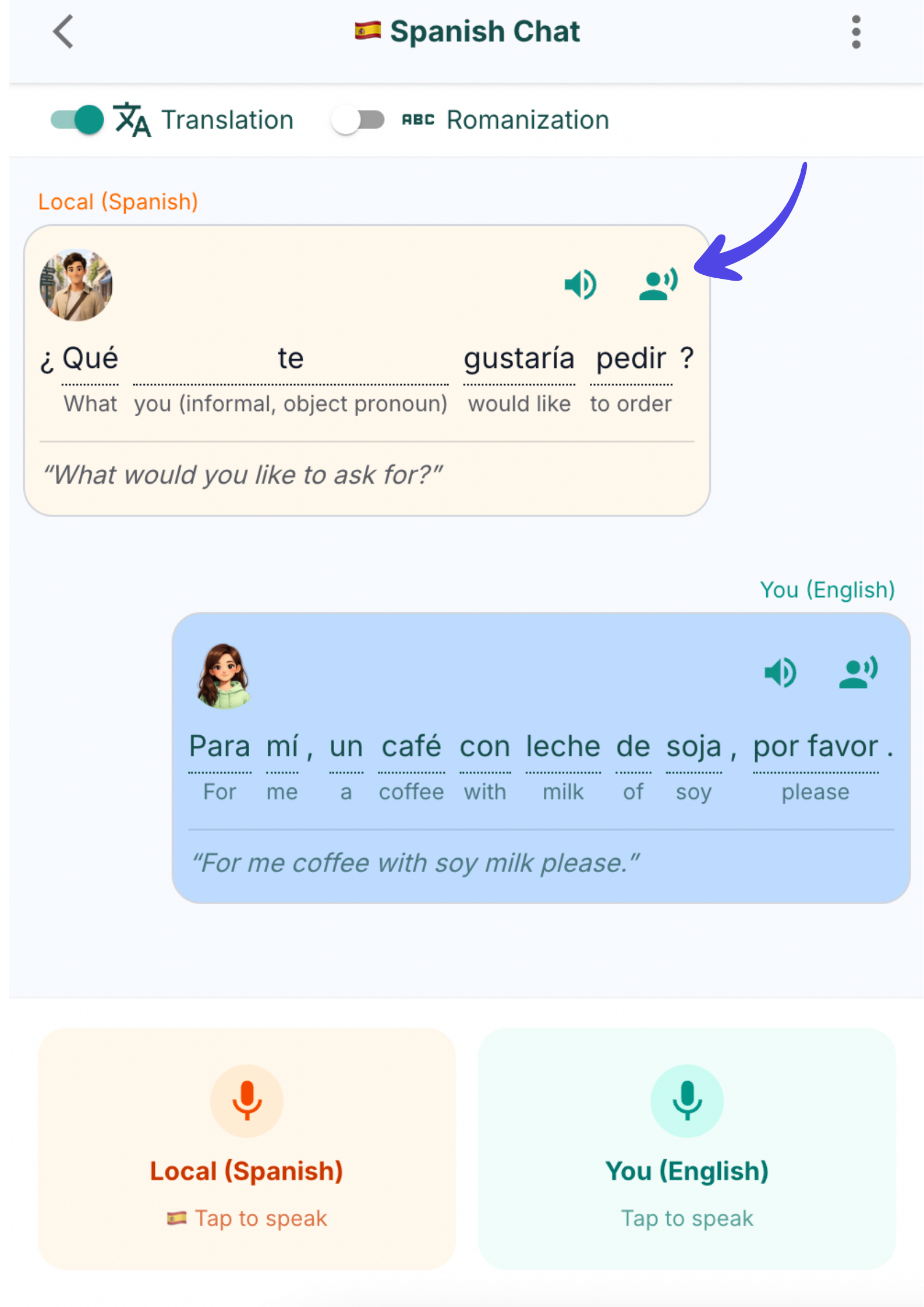
Their voice, saved. Study it after the conversation ends.
The arrow shows the recording button on the local's message. Every sentence they speak is saved throughout the conversation. When you are done, tap any sentence to hear exactly how they said it: their natural pace, their real accent, their connected speech. A 10-minute conversation with a local becomes revision material you can return to for as long as it takes to absorb it.
Free forever plan · No credit card required
Try a free conversation with a local →How to Start a Conversation (Practically)
The first conversation is the hardest. These approaches make it easier.
Choose low-stakes settings. Markets, cafes, and community events are better starting points than formal or professional situations. The pressure is lower, the interactions are shorter, and partial success feels like a win rather than a failure.
Prepare three opening lines in advance. You do not need to prepare the whole conversation. Just the first three sentences. "I'm learning Korean, so please be patient with me." "Could you recommend something?" "I love this neighbourhood." Having these ready removes the cold-start panic that stops most learners.
Ask questions, do not make speeches. Questions shift the conversational burden to the native speaker, which is exactly right at beginner level. People enjoy talking about themselves and their expertise. Your job is to listen, understand as much as you can, and ask the next question. This is genuine conversation and it requires far less language production than trying to tell a story.
Use your target language for what you can, translation for the rest. Do not switch to a common language the moment things get difficult. Use your target language for everything you can manage, even if that is only single words and pointing. Use real-time translation for the parts where communication genuinely breaks down. This keeps the conversation in the language you are learning and makes the interaction feel like practice, not like a translation exercise.
Turning Conversations into Study Material
A real conversation with a native speaker is one of your richest sources of learning material, but only if you review it.
After a conversation, note the vocabulary you encountered but did not know. Note the phrases the native speaker used naturally that you would not have thought to say. Note the topics that derailed you. These are your next learning priorities, and they come directly from language you actually need in real situations, not from a curriculum someone else designed.
PalmSpeak's conversation replay saves and replays your translated conversations, letting you study the vocabulary and phrases from your actual exchanges. Every conversation generates a reviewable record of what was said, in context. This turns a 20-minute exchange with a native speaker into ongoing study material.
The learners who improve fastest from native speaker conversations are the ones who treat each conversation as both a practice session and a study source, not just one or the other.
The Mindset Shift That Makes This Sustainable
Most learners approach native speaker conversations as a performance: something to be evaluated, where mistakes are failures. This framing makes the experience stressful and produces avoidance.
Native speakers almost never share this framing. Most people, when someone makes a genuine effort to speak their language, respond with warmth and patience. The mistakes that feel mortifying to you are background noise to them. What they notice is the effort and the genuine interest in connecting.
Shift the goal from performance to connection. You are not there to demonstrate your language level. You are there to have a real exchange with another person, in whatever combination of languages makes that possible. This framing is not just psychologically healthier. It also produces better language learning, because relaxed, genuine conversation is richer input and produces more natural output than stressed, performance-focused exchanges.
One genuine conversation with a local is worth more for your long-term motivation than ten hours of solo practice. Make it a regular part of your learning, not a milestone you are building toward.
PalmSpeak
Practice Speaking From Day One
Jump into a structured scene and practice speaking in context: no partner needed, no judgment, available any time.
Free forever plan · No credit card required
Start a free conversation →Common Mistakes to Avoid
Waiting until you are fluent to talk to native speakers
Fix: Fluency is developed through real conversations, not in preparation for them. Waiting until you are fluent to talk to native speakers is like waiting until you can swim before getting in the water. The conversations you are delaying are the very thing that produces the fluency you are waiting for.
Apologizing constantly for your language level
Fix: A brief, upfront acknowledgment that you are learning is useful. Repeated apologies throughout a conversation are not. They shift the focus from communication to your performance, make the native speaker feel they need to manage your feelings, and undercut the natural flow of the exchange. Say it once, then focus on the conversation.
Continue Reading
Speaking GuideReal-time
Real-Time Translation: How to Talk to Locals Right Now
Not ready to wait? Here is how to have that conversation today with live translation
Read more →
Confidence
How to Overcome Speaking Anxiety When Learning a Language
If anxiety is what is stopping you from starting these conversations, begin here
Read more →
Hub Guide
How to Speak a Language Fluently: The Complete Practice Guide
The full speaking guide covering every stage of development
Read more →
Frequently Asked Questions
How do I find native speakers to practice with?
Is it rude to use a translator when talking to native speakers?
What should I talk about with a native speaker as a beginner?
How much does talking to native speakers actually help my fluency?
The conversation is waiting.
PalmSpeak guides you into real speaking situations from your first session. No partner needed, no prep required.
Free forever plan · No credit card required
Start a free conversation →