How to Use the Shadowing Technique to Sound More Natural
Shadowing, speaking simultaneously with native audio, trains natural speech patterns faster than almost any other solo method, if done properly.
Shadowing is a speaking technique where you listen to native audio and speak along at the same time, matching the rhythm, intonation, and sounds as closely as possible. Done regularly with short, understood clips, it trains natural pronunciation and speech patterns faster than almost any other solo method.
What Shadowing Is
Shadowing is a speaking practice technique where you listen to a native speaker and speak simultaneously, trying to match their rhythm, intonation, pace, and sounds as closely as possible. You are not translating. You are not thinking about grammar. You are borrowing a native speaker's speech and running it through your own voice in real time.
The technique was popularised in language learning by the linguist Alexander Arguelles, who used it as part of an intensive self-study approach. Its effectiveness for pronunciation and rhythm has been supported by research on motor learning and speech production since then.
What makes shadowing distinct from other listening and speaking exercises is the simultaneity. You are not listening and then repeating. You are listening and speaking at the same moment. This forces your brain to process and produce language at native speed, which trains patterns that slower, more deliberate practice cannot reach.
Why It Works: The Science
Natural speech is not a sequence of individual sounds produced in isolation. It is a stream of sound shaped by rhythm, stress, intonation, and the way words influence each other at boundaries. When "did you" becomes "didja", when "going to" becomes "gonna", when an unstressed syllable disappears entirely, these are not mistakes. They are the patterns of natural connected speech.
These patterns are extremely difficult to learn from a textbook or from isolated word drilling, because they emerge from language produced at natural speed. Slowing speech down to study it removes the very patterns you are trying to learn.
Shadowing trains connected speech directly. Because you are producing language simultaneously with a native speaker at their natural pace, you are forced to process and produce these patterns in the context where they actually occur. Over repeated sessions, your brain and vocal cords develop the motor programs for natural-sounding speech in the same way a musician develops the motor programs for their instrument: through repetition of the real patterns at the real speed.
Research on skill acquisition also shows that motor programs are most efficiently built when practising close to the target performance level, not at a slowed-down study pace. Shadowing at native speed is harder than shadowing at 70% speed, but it builds the right patterns more efficiently.
How to Shadow: Step by Step
Step 1: Choose your material. Select audio with a transcript or subtitles available. A podcast episode, YouTube video, or news broadcast works well. The speaker should be clear and the content should be material you understand at least 70% of. Start with one to two minutes of content per session.
Step 2: First listen without speaking. Play the audio once and focus on getting the overall meaning and emotional shape of what is being said. Notice the speaker's overall rhythm. Do not try to shadow yet.
Step 3: Shadow in segments. Play the audio again and speak simultaneously. Start with segments of five to ten seconds, then gradually extend to longer passages as you become comfortable with the material. Speak loudly enough to hear your own voice clearly.
Step 4: Focus on rhythm and intonation, not perfection. You will not match the speaker perfectly. That is fine. Prioritise matching the overall rhythm and stress patterns rather than individual sounds. Catching the flow is more important than catching every phoneme.
Step 5: Record your shadowing attempt. Record yourself shadowing and then play back both your version and the original. Listen for the two or three biggest differences. Where does your version lag behind? Where does your stress pattern deviate? These are your focus points for the next session on the same passage.
Step 6: Repeat the same passage. Use the same passage for a minimum of five sessions before switching to new material. The first session is orientation. The second and third sessions are where real pattern learning begins. By session five or six, many learners find the passage feels almost completely automatic, which is exactly the goal.
Choosing the Right Shadowing Material
The material you shadow matters almost as much as how you shadow it. Poor material choices produce slow progress even with technically correct shadowing technique.
Level. Slightly above your current spoken level. You want some linguistic stretch without so much difficulty that you cannot follow the meaning at all.
Speed. Natural native speed. Not slowed-down audio designed for learners. Slowed audio removes the connected speech patterns that shadowing is designed to train. If the original is too fast for you, choose a different speaker rather than slowing the audio down.
Clarity. A clear speaker with minimal background noise. Podcast interviews work well. Crowded room recordings do not.
Content familiarity. Topics you understand, not topics you would have to look up. Your attention should be on production, not on comprehension. If you are spending cognitive energy decoding meaning, you have less available for matching the speech patterns.
Consistency. Use the same speaker for at least a few weeks before switching. Different speakers have different speech patterns, and the efficiency of shadowing comes from learning one speaker's patterns deeply rather than sampling many speakers broadly.
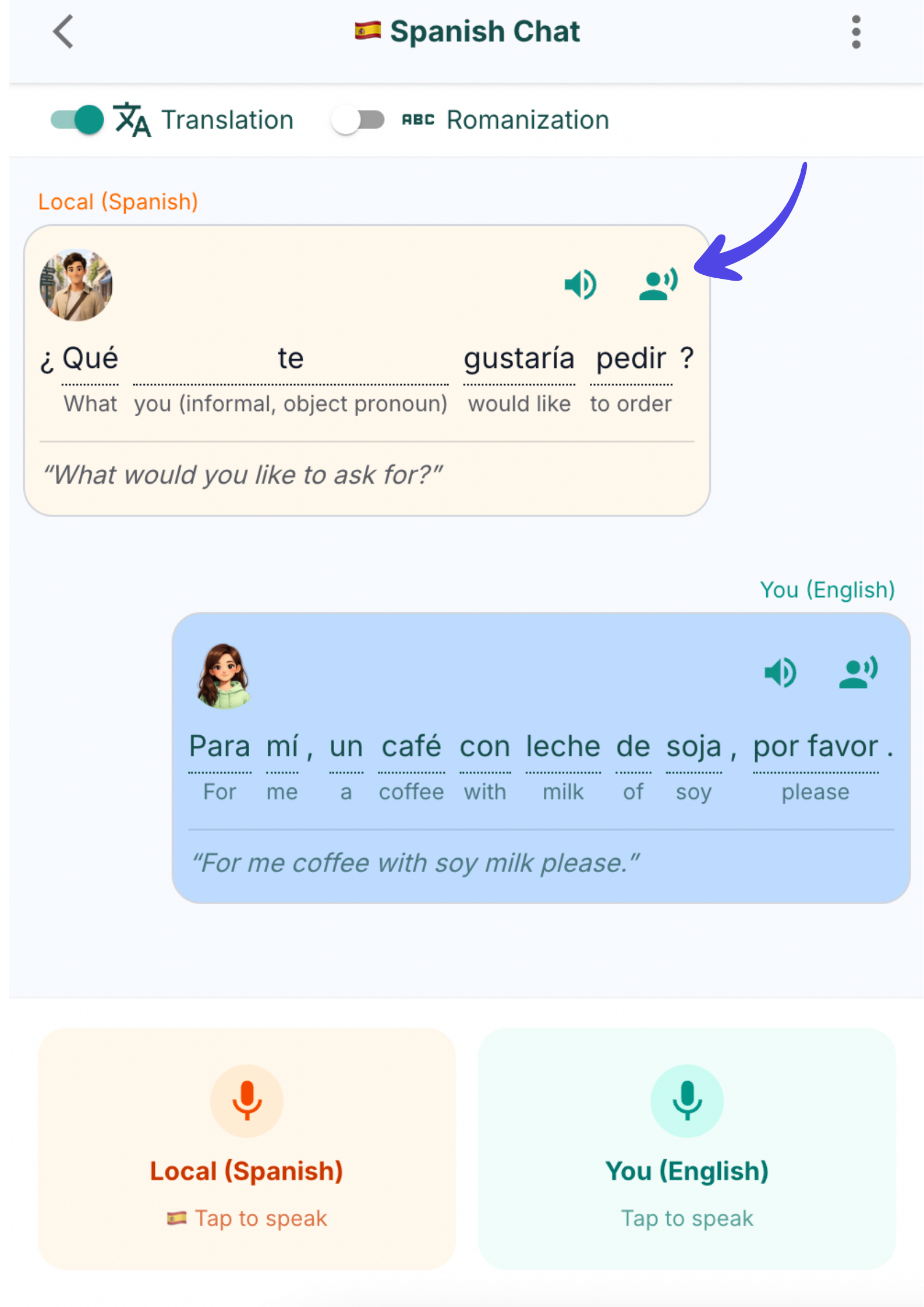
Native speaker audio available through PalmSpeak's Talk feature gives you authentic local speech in your target language, which is ideal for shadowing material: genuine, natural-speed, culturally authentic conversation.
Shadow real locals, not studio recordings
When you chat with a local through PalmSpeak, the conversation is saved. Listen back anytime to hear exactly how they said it in the foreign language: their natural rhythm, intonation, and connected speech. That recording becomes your shadowing material: real native speech from a real exchange, not a rehearsed script.
Free forever plan · No credit card required
Start a free conversation →Shadowing vs Other Methods
Shadowing vs pronunciation drilling. Pronunciation drilling targets individual phonemes in controlled conditions. Shadowing targets rhythm, connected speech, and prosody in the context of real speech. Both have a role. Drilling addresses specific sounds that are wrong; shadowing addresses the overall naturalness of how sounds flow together. Use drilling for your top three problem sounds; use shadowing for overall speech naturalness.
Shadowing vs AI conversation practice. Shadowing is passive mimicry: you are borrowing a native speaker's sentences. AI conversation is active production: you are generating your own sentences under mild pressure. These are different training stimuli that develop different capabilities. Shadowing builds motor patterns and naturalness. AI practice builds retrieval speed and conversational fluency. They complement each other and should both be part of a complete speaking practice routine.
Shadowing vs listening practice. Listening practice builds comprehension: you are training your ear to decode natural speech. Shadowing builds production: you are training your voice and mouth to produce natural speech. Some learners confuse them because both involve listening to native audio. The difference is output. If you are not speaking out loud simultaneously, you are doing listening practice, not shadowing. Both are useful; neither substitutes for the other.
PalmSpeak
Practice Speaking From Day One
Jump into a structured scene and practice speaking in context: no partner needed, no judgment, available any time.
Free forever plan · No credit card required
Start a free conversation →Common Mistakes to Avoid
Shadowing material that is too difficult
Fix: Shadowing works by training motor patterns. If you cannot follow the meaning of what you are shadowing, you are just producing sounds without a cognitive anchor. Choose material where you understand at least 70% of the content. You are training speech production, not comprehension. The content should be familiar enough that your brain can focus on the production, not on decoding.
Switching material before it is automatic
Fix: A single shadowing session with a passage does not consolidate the patterns. The improvement comes from repetition: the same passage five, seven, even ten times over multiple sessions. Switching material after one or two attempts is the single most common reason shadowing practice produces disappointing results. Stay with one passage until it feels completely automatic before moving on.
Treating it like a listening exercise
Fix: Shadowing is an output exercise. You must speak out loud, simultaneously with the audio. Mouthing the words, sub-vocalising, or speaking after a delay all miss the mechanism that makes shadowing work. The simultaneous production at native speed is the training stimulus. If you are not speaking loudly enough to hear your own voice clearly, you are not getting the full benefit.
Continue Reading
Speaking GuidePronunciation
How to Improve Pronunciation: A Step-by-Step Guide for Adult Learners
Combine shadowing with targeted phoneme work for the fastest pronunciation gains
Read more →
Solo practice
How to Practice Speaking a Language Alone (Without a Partner)
Shadowing is one of five solo methods: see how they fit together
Read more →
Core skill
Fluency vs Accuracy: Which to Focus on First in Language Learning
Understand where shadowing fits in the fluency-accuracy framework
Read more →
Frequently Asked Questions
What is the shadowing technique in language learning?
Is shadowing actually effective for language learning?
How often should I practise shadowing?
What is the difference between shadowing and listening practice?
Can I shadow without understanding everything?
The conversation is waiting.
PalmSpeak guides you into real speaking situations from your first session. No partner needed, no prep required.
Free forever plan · No credit card required
Start a free conversation →