Translations Lost After a Conversation: How to Fix It
Every real conversation generates vocabulary you needed in context, most of which disappears the moment it ends. Here is how to capture it.
Vocabulary from a real conversation disappears afterward not because of poor memory but because nothing captured it. Save the words and phrases you met in context immediately after talking, along with the sentence they appeared in, so the highest-value input becomes lasting acquisition instead of being lost.
You just had a 20-minute conversation with a native speaker, managed to communicate, encountered a dozen words you had never seen before in a context that made their meaning clear. Then you close the app and all of it, the vocabulary, the phrases, the grammatical patterns, is gone.
This is not a memory failure. It is a system failure. The conversation generated exactly the kind of vocabulary input that produces lasting acquisition, and no mechanism was in place to capture it.
Why Conversation Vocabulary Disappears
Most translation tools are built for communication, not for learning. They display the translation in real time and then discard it. From a communication standpoint, this is fine. The message was understood. From a language learning standpoint, it wastes the most valuable study material a learner can generate.
Ebbinghaus's forgetting curve is relevant here: without deliberate re-exposure, you lose around 70% of new information within 24 hours and more than 90% within a week. But the decay rate is not fixed. It depends on how deeply the information was encoded when you first encountered it. Words encountered during a real conversation, where you had a communicative reason to understand them, are encoded more richly than words from a vocabulary list. They are worth fighting harder to retain.
The problem is not that the vocabulary was encountered and forgotten. The problem is that no review happened to convert that initial encounter into a lasting memory trace.
Why This Vocabulary Is Worth Saving
Not all vocabulary is equally worth capturing. High-frequency words from textbooks matter. Words encountered in a real conversation about topics you actually care about, spoken by a real person in a real register, matter more.
Nation's research on vocabulary acquisition establishes that words need multiple exposures across varied contexts before they move from passive recognition to active retrieval. A real conversation counts as one of those exposures, and it is among the richest kind: the word arrived in a genuine communicative context, with a reason attached to it. Reviewing that same word in the same conversation context counts as a second exposure that deepens the same encoding rather than building a separate one.
The learner who has 50 reviewed conversation exchanges has encountered their vocabulary in 50 real-world contexts. The learner who has studied the same words from a textbook list has encountered them in one: the list. The breadth of contextual encoding is not comparable.
The Review System That Fixes It
The fix is straightforward and takes less time than most learners expect. After any translated conversation:
- Review the exchange within 24 hours. This is the highest-leverage moment. Skim the conversation for words you translated that you do not already know. These are your targets.
- Identify high-frequency vocabulary. Words that appeared more than once in the conversation are especially worth capturing: they are high-frequency in that context and likely to recur in similar conversations.
- Add to your review system with the original sentence. Move the words into your spaced repetition review, but attach the full sentence they appeared in as the retrieval cue. A bare definition is a single retrieval pathway. A sentence from a real conversation is three or four.
- Listen back if audio is available. Hearing how your conversation partner naturally said a phrase trains your ear to the rhythm and register of real spoken language in a way that reading the transcript alone cannot.
This system adds roughly 10 to 15 minutes per conversation. The return is that every conversation compounds: the vocabulary from each exchange accumulates in your review system, where it is reinforced over weeks rather than forgotten overnight.
Conversation Review in Practice
PalmSpeak's conversation review is built around this principle. Every translated exchange with a local is saved and replayable. When you return to the conversation, you see the full exchange with vocabulary highlighted. Each word you save from the conversation is queued for review immediately, carrying the original sentence as context rather than a bare definition.
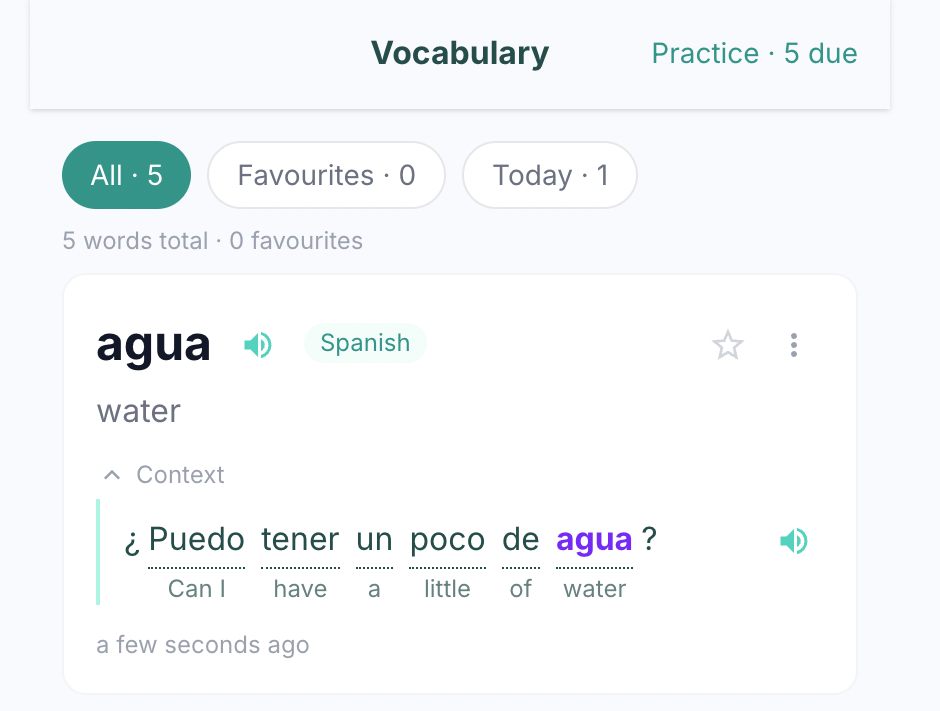
Every saved word, in the sentence where you needed it.
The context section shows the exact sentence the word appeared in during your conversation, with word-by-word translation directly below. Save a word from a real exchange and this is what review looks like: not a definition on a blank card, but the moment the word became relevant to you.
Free forever plan · No credit card required
Start saving vocabulary in context →The review session presents the conversation sentence and asks you to recall the translation or produce the word in the target language. This is retrieval practice in the conditions closest to real use: a sentence from a real conversation, not an isolated word pair. Research on retrieval practice consistently shows that review conditions that match real-use conditions produce stronger transfer to actual performance.
Each conversation you have is also a piece of listening material. Your conversation partner's audio is preserved, so you can hear exactly how they said a phrase at natural speed: their rhythm, intonation, and connected speech. That recording becomes shadowing material, vocabulary review material, and pronunciation reference simultaneously. For more on how to use real conversation audio for shadowing, see the guide to real-time translation with locals.
PalmSpeak
Practice Speaking From Day One
Jump into a structured scene and practice speaking in context: no partner needed, no judgment, available any time.
Free forever plan · No credit card required
Start a free conversation →Common Mistakes to Avoid
Reviewing conversation vocabulary as a bare word list
Fix: Copying words from a conversation into a list and reviewing them without context discards the most valuable part of the original encounter: the sentence where the word was needed. A word you encountered in a real exchange already has situational and communicative associations attached to it. Review it in the original sentence. Remove the sentence and you reduce a contextually encoded word to something barely stronger than a list word.
Waiting more than 24 hours to review a conversation
Fix: Ebbinghaus's forgetting curve shows you lose roughly 70% of new information within 24 hours without re-exposure. The review window for conversation vocabulary is the same evening, not the following weekend. A 10-minute review of the exchange the same night it happened dramatically changes how much vocabulary survives into the following week. Schedule the review before you close the app, not as a separate task you will return to later.
Continue Reading
Vocabulary GuideRetention
Why Do I Keep Forgetting Vocabulary I've Studied?
The forgetting curve, retrieval practice, and the two-stage system that keeps words from disappearing
Read more →
Hub Guide
How to Learn and Remember Vocabulary in Any Language
The complete vocabulary guide covering how words are acquired and retained long-term
Read more →
Frequently Asked Questions
Is there an app that saves my translated conversations so I can review them later?
Why is reviewing translated conversations useful for language learning?
How do I turn a translated conversation into a language lesson?
How soon after a conversation should I review it?
The conversation is waiting.
PalmSpeak guides you into real speaking situations from your first session. No partner needed, no prep required.
Free forever plan · No credit card required
Start a free conversation →