Why Do I Keep Forgetting Vocabulary I've Studied?
Forgetting vocabulary you studied is not a memory problem, it is a method problem. The same brain retains words for years when learned the right way.
Forgetting studied vocabulary is a method problem, not a memory problem. Words fade when learned as isolated translation pairs and reviewed all at once. They last when met in context and reviewed at increasing intervals through spaced repetition and active recall.
Forgetting vocabulary is not a sign you are bad at languages. It is how human memory works by default. The question is not whether you will forget words you study — you will. The question is whether you are studying in a way that fights this tendency or amplifies it.
Most vocabulary study amplifies it. Here is why, and exactly what to do instead.
The Ebbinghaus Forgetting Curve
Hermann Ebbinghaus spent years in the 1880s memorising nonsense syllables and testing his own recall at intervals. His finding became one of the most replicated results in cognitive psychology: without deliberate re-exposure, memory decays exponentially. He lost roughly half of new material within the first day, 70% within a week, and close to 90% within a month.
This is not a pathology. It is the brain conserving energy. Your brain processes enormous quantities of information every day. Without a signal that specific information is worth keeping, it discards it. The forgetting curve is your brain's default cleanup routine.
The word list you studied last Tuesday? Your brain had no reason to believe those 30 words were important. You never used them. No one asked for them. They disappeared.
Why Isolated Word Study Fails Fastest
A word studied in isolation has a single memory pathway: the pairing between the target word and its translation. When that pathway weakens, which it does within hours, the word becomes unretrievable. There is no backup route into the memory.
This is the core problem with studying vocabulary from lists. Even if you review the list multiple times, you are rebuilding the same single pathway each time. The word never develops the richer network of associations that would make it robust.
Compare this to a word you encountered during a real conversation. You remember who you were talking to. You remember the topic and why the word was relevant. You remember making the effort to find the translation. The word has semantic associations (its meaning), situational associations (the conversation context), and sometimes emotional associations (embarrassment at not knowing it, relief when you understood). That is a word that can survive the forgetting curve, because even if one retrieval pathway weakens, several others remain.
How Retrieval Practice Resets the Curve
Roediger and Karpicke's 2006 research established what they called the testing effect: the act of retrieving information from memory, even imperfectly, strengthens that memory more than re-reading or re-studying the same material. This is counterintuitive. Most learners assume they learn by putting information in. The evidence suggests they learn far more by pulling it back out.
Every time you successfully retrieve a word, you reset its forgetting curve. The next forgetting interval starts fresh from that moment, and crucially, it tends to lengthen. The first retrieval might hold for 24 hours. The second for three days. The third for a week. Over time, a word you have retrieved successfully five or six times needs to be reviewed only once a month to stay sharp.
This is the principle behind spaced repetition systems. They do not ask you to review everything at equal intervals. They track which words you retrieved easily and which you struggled with, and they schedule the next review accordingly. Words you know well are shown less often. Words you keep forgetting are shown more often. The system optimises your review time for retention rather than repetition.
But retrieval practice has a prerequisite: you need to have an initial encoding strong enough to retrieve. A word encountered once in a list produces an encoding too weak to test reliably. A word encountered in a meaningful context, with retrieval practice starting within 24 hours, produces an encoding that responds well to the spaced review schedule.
Why Context Matters So Much
Memory research has consistently shown that richer encoding at the point of first encounter produces stronger and more durable memories. Context contributes to richness in several ways that word lists cannot replicate.
When you encounter a word in a real conversation, your brain encodes not just the word and its meaning but the situation in which you needed it. This situational encoding means the word is linked to a broader memory network. When you are later in a similar situation, the word becomes accessible not just through its translation but through its situational associations.
Context also provides collocational information that isolation cannot: how the word naturally combines with other words, what register it belongs to, whether it is formal or casual, what kind of speaker uses it. A word encountered in conversation arrives with this pragmatic information attached. A word from a list arrives alone.
For vocabulary to move from passive recognition into active production, the research of Paul Nation and others consistently points to the need for multiple meaningful encounters across varied contexts. A word seen 15 times in a list has had one context repeated 15 times. A word encountered 15 times across different conversations has 15 distinct contextual encodings, each adding resilience to the memory network.
The Spacing Effect and Optimal Intervals
Cepeda and colleagues, in a 2006 meta-analysis of spacing effect research, found that the optimal gap between study sessions depends on how long you need to retain the information. For long-term retention measured in months, reviewing at roughly 10 to 20% of the retention interval is close to optimal. If you need to remember something for a year, reviewing it once every one to two months is efficient.
For practical vocabulary learning, this translates to a schedule something like: within 24 hours of first encountering a word, then three days later, then one week, then two weeks, then one month, then three months. Each successful review extends the next interval. Each failed retrieval resets it, treating the word as partially new.
This schedule is too complex to manage manually for a growing vocabulary. Spaced repetition software handles the scheduling automatically, which is why it outperforms manual review systems in long-term retention studies. But the software only works well if the initial encoding was strong. A word entered into a spaced repetition system from a real conversation review session will perform better than the same word entered from a list, because the initial encoding is richer and the first several retrievals will be more successful.
The Best System for Vocabulary Retention
The research points to a two-stage system that most learners are not using.
Stage one: encounter vocabulary in context. Real conversations with native speakers produce the richest contextual encoding. AI roleplay scenes produce good contextual encoding in a lower-stakes environment. Graded reading and native audio at your level produce weaker contextual encoding but still substantially stronger than word lists. The goal at this stage is not to study vocabulary deliberately but to encounter it meaningfully, so the initial encoding carries situational and pragmatic associations.
Stage two: review with retrieval practice within 24 hours. After any conversation or reading session where you encountered new vocabulary, return to those words within the same day. Identify which ones you want to retain actively. Enter them into a spaced repetition review system with the original sentence as context. Then follow the scheduled review intervals without skipping.
This system works because it combines the encoding richness of contextual learning with the retrieval efficiency of spaced repetition. Either stage alone produces results. The two together produce substantially better retention with less total time spent reviewing.
The word and the sentence it came from, saved together.
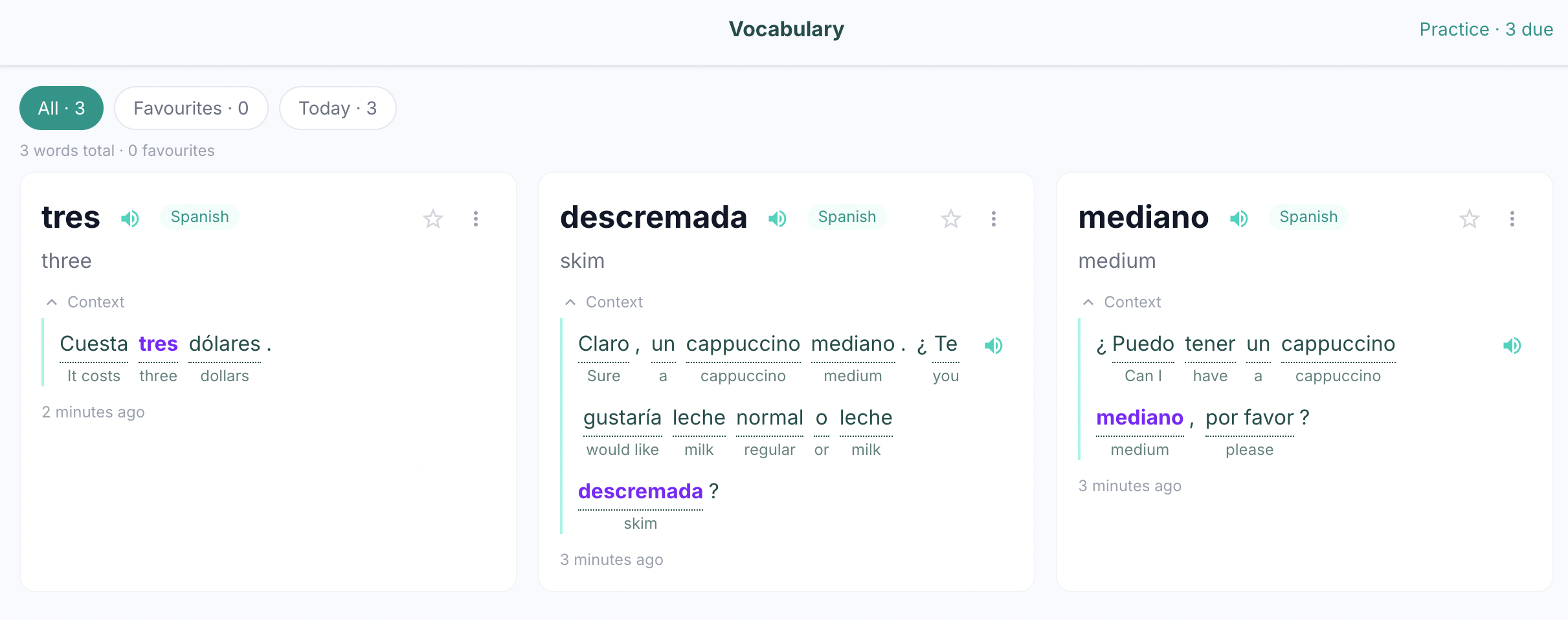
When you save a word during a PalmSpeak conversation scene, the full sentence it appeared in is saved with it automatically: the original sentence, word-by-word translation, and the moment you first encountered it. When you review, you review the word in the context where you needed it, not as an isolated pair against a blank background. This is the contextual encoding the research describes, built into the review habit from the first save.
Free forever plan · No credit card required
Start building vocabulary that sticks →For the specific habit of saving vocabulary from real translated conversations before it disappears, see the guide to translations lost after the conversation ends. For how to use real conversations as your primary vocabulary source, see the real-time translation with locals guide.
PalmSpeak
Practice Speaking From Day One
Jump into a structured scene and practice speaking in context: no partner needed, no judgment, available any time.
Free forever plan · No credit card required
Start a free conversation →Continue Reading
Vocabulary GuideFrequently Asked Questions
Why do I keep forgetting vocabulary I studied?
How do I retain vocabulary long-term?
Should I use a spaced repetition app for vocabulary?
How many exposures does it take to learn a vocabulary word?
The conversation is waiting.
PalmSpeak guides you into real speaking situations from your first session. No partner needed, no prep required.
Free forever plan · No credit card required
Start a free conversation →